There is an interesting statement in 1 Corinthians 1:17:
For Christ did not send me to baptize, but to preach the gospel--not with words of human wisdom, lest the cross of Christ be emptied of its power.
Paul had one task in mind when he ministered: Preach the gospel. Let's expand on this thought for a moment.
1. Paul didn't assume the Great Commission to be something he had to carry out by himself. He did the "Go into all the world" part, but not the "baptizing them" part. Why? Because it isn't the call on any one person's life to carry out all of the Great Commission alone. It is a call to the entire church body working in one accord. Paul preached the gospel, and other than a few people, let someone else do the baptizing and the "Teaching them to obey everything I have commanded" (discipling) parts.
2. Paul didn't try to impress the lost with his human insights - he simply spoke of the power of the cross. We are all sinners in need of a Savior. Jesus is that Savior. Without Him, we are all condemned. On the cross He took that condemnation on Himself; we are no longer condemned. If you believe in Jesus' sacrifice as the efficient full-payment for your sins, and choose to obey Him out of love and thanksgiving, you are no longer a sinner, but now are a saint.
3. Paul believed using human wisdom emptied the cross of its power. Some might say that Jesus used parables to help illustrate the message He has for the world. Since His stories helped people understand His gospel, we should use human wisdom and stories to help them understand, too. Actually, though, Jesus didn't use parables to help them understand. Mark 4:11-12 tells us why Jesus spoke in parables:
He told them, "The secret of the kingdom of God has been given to you. But to those on the outside everything is said in parables so that,
" `they may be ever seeing but never perceiving,
and ever hearing but never understanding;
otherwise they might turn and be forgiven!' "
The parables are clear to those who believe, but confound those who do not. Why? Because we depend on the Holy Spirit to make the word clear to us.
The man without the Spirit does not accept the things that come from the Spirit of God, for they are foolishness to him, and he cannot understand them, because they are spiritually discerned. - 1 Cor. 2:14
So Paul was saying that trying to help people change because of human reasoning defies the message of the cross. If people could understand and change just because of human wisdom, Jesus would not have had to die. Therefore the cross was unnecessary and is "emptied of its power".
Therefore, we must pray for lost people, that God, by His Spirit, would give them understanding of the very basic truth we are teaching them. The gospel that saves stands on its own merit. You and I cannot make it better - more interesting, more effective or more acceptable.
For what part of the Great Commission do you believe you are especially gifted? To what calling is your life directed? Do you pray for your lost friends and family? Lost enemies? Do you speak the gospel truth when the opportunity arises?
Thursday, November 15, 2007

Tuesday, October 30, 2007
Immitating God
Ephesians 5:1 tells us to imitate God, as dearly loved children. Have you ever really considered that possibility? Here are a few truths to think about when it comes to this teaching:
1. You can't imitate God. How often does God sin? How often does He do what is right?
You are flawed and human and it is impossible for you to reach that level of perfection that only God attains. So why did He say through Paul to imitate Him? Does God give us impossible standards to live up to? I would love to get your feedback on this question before I give my thoughts on it.
2. Churches aren't teaching us to do this. We are so concerned with trying to keep people from giving up in the "race" we are all running that we make everyone comfortable with their sins and failures. The "victorious church" has given up the pursuit of holiness and accepted the chalice of defeat. We drink from it together as we claim the grace of God to excuse our sinfulness, and claim Romans 7:19 as our life's verse:
"For what I do is not the good I want to do; no, the evil I do not want to do--this I keep on doing."
3. We try to get people who are not children of God to act like children of God. We have become effective at getting people to look and act right on the outside without ever challenging them to believe in Jesus for their salvation and lay their lives down for Him. Only those who receive Jesus and believe in His Name are given the right to become children of God (John 1:12)! Not everyone is God's child. Therefore, teaching people how to behave like one is an exercise in futility. Only by the power of the Holy Spirit in us - that power that comes to live in us when we are crucified with Christ - can we imitate God as dearly loved children.
4. Daily consider how you can imitate God in your circumstances.
Are things going well at home? At work? At church? In your mind and heart? Are you giving God glory publicly, or do you save that "church stuff" for Sundays and keep it private? Are you praying as fervently as you would in hard times? Are you taking credit for God's blessings?
Are things going badly at home, work, church or inside of you? How do you treat people in this moment? How do you respond to God's allowing of these events on your life? Are you working hard at your job - as unto the Lord and not to men? Are you loving your family unconditionally? Are you loving your enemies and blessing those who persecute you?
There are many more truths here. The fact is that the definition of a Christian is a "Christ follower" or "Christ imitator". If you were trying to give a quick definition of what a Christian is, I am guessing you would say, "A believer in Jesus Christ." I believe it is more than that!
How's this for a quick definition of a Christian:
A believer in Jesus Christ who lays down His life and takes on the life of Christ.
1. You can't imitate God. How often does God sin? How often does He do what is right?
You are flawed and human and it is impossible for you to reach that level of perfection that only God attains. So why did He say through Paul to imitate Him? Does God give us impossible standards to live up to? I would love to get your feedback on this question before I give my thoughts on it.
2. Churches aren't teaching us to do this. We are so concerned with trying to keep people from giving up in the "race" we are all running that we make everyone comfortable with their sins and failures. The "victorious church" has given up the pursuit of holiness and accepted the chalice of defeat. We drink from it together as we claim the grace of God to excuse our sinfulness, and claim Romans 7:19 as our life's verse:
"For what I do is not the good I want to do; no, the evil I do not want to do--this I keep on doing."
3. We try to get people who are not children of God to act like children of God. We have become effective at getting people to look and act right on the outside without ever challenging them to believe in Jesus for their salvation and lay their lives down for Him. Only those who receive Jesus and believe in His Name are given the right to become children of God (John 1:12)! Not everyone is God's child. Therefore, teaching people how to behave like one is an exercise in futility. Only by the power of the Holy Spirit in us - that power that comes to live in us when we are crucified with Christ - can we imitate God as dearly loved children.
4. Daily consider how you can imitate God in your circumstances.
Are things going well at home? At work? At church? In your mind and heart? Are you giving God glory publicly, or do you save that "church stuff" for Sundays and keep it private? Are you praying as fervently as you would in hard times? Are you taking credit for God's blessings?
Are things going badly at home, work, church or inside of you? How do you treat people in this moment? How do you respond to God's allowing of these events on your life? Are you working hard at your job - as unto the Lord and not to men? Are you loving your family unconditionally? Are you loving your enemies and blessing those who persecute you?
There are many more truths here. The fact is that the definition of a Christian is a "Christ follower" or "Christ imitator". If you were trying to give a quick definition of what a Christian is, I am guessing you would say, "A believer in Jesus Christ." I believe it is more than that!
How's this for a quick definition of a Christian:
A believer in Jesus Christ who lays down His life and takes on the life of Christ.
Friday, July 06, 2007
A Solid Foundation
Have you ever tried to describe something to someone who has never seen the item before? Once you have done your best to describe it, they have a picture in their minds of what that item looks like, whether it is a correct interpretation or not.
For instance, if I described a piano to you, I might do it like this:
A piano is a kind of wooden box with keys on it. When you push a key down, there is a hammer connected to it that strikes a wire string, causing the string to vibrate. This vibration makes a sound whether high or low, based on how tightly the string is wound. The harder you hit the key, the louder the sound will be, and the tighter the strings, the higher the sound. There are three pedals on the bottom of the piano, and when you push them, they can stop the vibrations instantly, or make them vibrate longer, depending on which pedal you push.
Now, if you have seen a piano before, you know that this description was an accurate overview of what a piano is and how it works. But in the listener's mind, they may have conjured up something like this:
 The information is all included in this picture, but it obviously does not look like what you know a piano to be.
This happens when we share our faith with people who have never heard or understood it before. Their perception of Christianity gets a little jumbled and confused in the translation from our words to their hearts. Like the piano to someone who has never seen a piano, Christianity is not as basic as we think it is when heard through the ears of someone to whom the message is completely foreign.
I think many people who accept the message at first get this kind of distorted view of Christianity. If this is true, what can follow as they build on this faulty vision of God and spread the word as they have interpreted it could be a disastrous. The perpetuation of misinterpreted descriptions can create a false doctrine, or, ultimately, a completely vain faith is something that Christianity is not.
How do we battle this human weakness and dangerous challenge?
1. Lay a solid foundation. The description given of the piano is solid. It is right in every sense. But it is only the basic information of the looks and workings of a piano. It is impossible to describe a piano with words alone to effectively relate the image of what a piano is and the explanation of what it does; however we do need a foundational frame of reference from which to work. This description is a great starting point.
2. Answer the questions you can. After you have laid the foundation in their minds, they may start to ask you questions. In Christianity, we would call this exchange of questions and answers to learn the whole truth, "discipleship". 2 Timothy 3:16 tells us that scripture is all from the breath of God, and is useful for teaching (getting the information out there), correcting (replacing wrong information with right information), rebuking (the "You know better than that," form of correction), and training in righteousness (teaching us a new way of life, not just informing us of information). The answers to almost every spiritual question can be found in this one standard: The Bible. Soon the piano starts to look more like a piano - Christianity starts to look more like Christianity.
3. Don't try to answer questions to which you don't know the answers. It seems to make sense...most of us wouldn't try to explain how a cell phone works, or how the internet works, but as Christians we feel we have to be able to explain how God works. Some things we can answer, because His word makes it clear, but in most things, God's ways are higher than ours and His thoughts are beyond our comprehension. Trying to explain God is a major temptation, but not ever completely possible. When the answer is "I don't know," use it.
If the person you described the piano to at the beginning of this post were to try to build his own piano, you would teach him, correct him, rebuke him and train him until his piano was an effective version of the "original". How can we do any less with the foundational truths of the bible when training people to live the Christian life?
For instance, if I described a piano to you, I might do it like this:
A piano is a kind of wooden box with keys on it. When you push a key down, there is a hammer connected to it that strikes a wire string, causing the string to vibrate. This vibration makes a sound whether high or low, based on how tightly the string is wound. The harder you hit the key, the louder the sound will be, and the tighter the strings, the higher the sound. There are three pedals on the bottom of the piano, and when you push them, they can stop the vibrations instantly, or make them vibrate longer, depending on which pedal you push.
Now, if you have seen a piano before, you know that this description was an accurate overview of what a piano is and how it works. But in the listener's mind, they may have conjured up something like this:
 The information is all included in this picture, but it obviously does not look like what you know a piano to be.
This happens when we share our faith with people who have never heard or understood it before. Their perception of Christianity gets a little jumbled and confused in the translation from our words to their hearts. Like the piano to someone who has never seen a piano, Christianity is not as basic as we think it is when heard through the ears of someone to whom the message is completely foreign.
I think many people who accept the message at first get this kind of distorted view of Christianity. If this is true, what can follow as they build on this faulty vision of God and spread the word as they have interpreted it could be a disastrous. The perpetuation of misinterpreted descriptions can create a false doctrine, or, ultimately, a completely vain faith is something that Christianity is not.
How do we battle this human weakness and dangerous challenge?
1. Lay a solid foundation. The description given of the piano is solid. It is right in every sense. But it is only the basic information of the looks and workings of a piano. It is impossible to describe a piano with words alone to effectively relate the image of what a piano is and the explanation of what it does; however we do need a foundational frame of reference from which to work. This description is a great starting point.
2. Answer the questions you can. After you have laid the foundation in their minds, they may start to ask you questions. In Christianity, we would call this exchange of questions and answers to learn the whole truth, "discipleship". 2 Timothy 3:16 tells us that scripture is all from the breath of God, and is useful for teaching (getting the information out there), correcting (replacing wrong information with right information), rebuking (the "You know better than that," form of correction), and training in righteousness (teaching us a new way of life, not just informing us of information). The answers to almost every spiritual question can be found in this one standard: The Bible. Soon the piano starts to look more like a piano - Christianity starts to look more like Christianity.
3. Don't try to answer questions to which you don't know the answers. It seems to make sense...most of us wouldn't try to explain how a cell phone works, or how the internet works, but as Christians we feel we have to be able to explain how God works. Some things we can answer, because His word makes it clear, but in most things, God's ways are higher than ours and His thoughts are beyond our comprehension. Trying to explain God is a major temptation, but not ever completely possible. When the answer is "I don't know," use it.
If the person you described the piano to at the beginning of this post were to try to build his own piano, you would teach him, correct him, rebuke him and train him until his piano was an effective version of the "original". How can we do any less with the foundational truths of the bible when training people to live the Christian life?
Thursday, June 28, 2007
Take it Personally!
The church needs to take care of this. The church needs to work on that. The church needs to...the church needs to...the church needs to...
I've found that when people say "The church needs to do something," they mean, "You need to do something, Pastor."
Did you know there is no magical organization out there called "The Church"? If the church needs to do something, it means you need to do something. It doesn't necessarily require a program to call on shut-in's or evangelize your neighborhood. If the church needs to do something, it means you need to do something; I need to do something; or we need to do something! You are "The Church".
We have separated ourselves from the persona of "The Church" as we have dropped denominational loyalties and consistency in attendance at our home churches. We start talking about the church as an "it" or a "them" rather than an "us" or "we", and suddenly, it is not a personal issue, it is a church issue for "The Church" to worry about.
This causes our conversations to turn toward complaining about "the Church". Why "they" aren't doing this or that; or how "The leadership" does something wrong; or that "No one from the church called me when I was absent," even though your best friends called, they attend your church (therefore they are the church), but that apparently doesn't count. That's when you know that "The Church" means "The Pastor," or "The Pastoral Staff".
Here is my plea to the people of "The Church": When someone says "The Church isn't doing this or that," take it personally! If you agree, then say, "You're right, I haven't been following up on people who miss services," or "You're right, we should be bringing food to that person who is unable to prepare their own meals right now."
You are the church! When someone says the church isn't doing what it should, they are saying you aren't doing what you should! Take it personally. Don't join in on the complaining, because it doesn't make any sense.
Think of it this way: Would you even consider complaining to your neighbor that you aren't keeping your house up well enough? Imagine the conversation:
You: "My house looks awful! I don't mow my lawn, the landscaping is all overgrown and run down, and the windows are all broken out. Somebody needs to do something about this!"
Your Neighbor: "I know! And I have three trashy cars parked in my yard up on blocks. Somebody should either fix them or get rid of them!"
That is exactly what you are doing when you and someone from your church complain about what "The Church" isn't getting done. It's always going to be a problem until "The Church" steps up and does something about it, and guess what?...YOU ARE THE CHURCH!
By the way, when I say "Take it personally," I don't mean, "Be offended." I mean:
* listen to what is being said
* consider the validity of their point
* ask them what they are doing to meet that need
* ask yourself what you are doing to meet this need
* If the need is bigger than you, go to the church leadership with ideas
* Be ready to help with the need you are raising
Philippians 2:14 says to do everything without complaining or arguing. It is time to stop complaining about "The Church", and start being "The Church".
Am I wrong?
I've found that when people say "The church needs to do something," they mean, "You need to do something, Pastor."
Did you know there is no magical organization out there called "The Church"? If the church needs to do something, it means you need to do something. It doesn't necessarily require a program to call on shut-in's or evangelize your neighborhood. If the church needs to do something, it means you need to do something; I need to do something; or we need to do something! You are "The Church".
We have separated ourselves from the persona of "The Church" as we have dropped denominational loyalties and consistency in attendance at our home churches. We start talking about the church as an "it" or a "them" rather than an "us" or "we", and suddenly, it is not a personal issue, it is a church issue for "The Church" to worry about.
This causes our conversations to turn toward complaining about "the Church". Why "they" aren't doing this or that; or how "The leadership" does something wrong; or that "No one from the church called me when I was absent," even though your best friends called, they attend your church (therefore they are the church), but that apparently doesn't count. That's when you know that "The Church" means "The Pastor," or "The Pastoral Staff".
Here is my plea to the people of "The Church": When someone says "The Church isn't doing this or that," take it personally! If you agree, then say, "You're right, I haven't been following up on people who miss services," or "You're right, we should be bringing food to that person who is unable to prepare their own meals right now."
You are the church! When someone says the church isn't doing what it should, they are saying you aren't doing what you should! Take it personally. Don't join in on the complaining, because it doesn't make any sense.
Think of it this way: Would you even consider complaining to your neighbor that you aren't keeping your house up well enough? Imagine the conversation:
You: "My house looks awful! I don't mow my lawn, the landscaping is all overgrown and run down, and the windows are all broken out. Somebody needs to do something about this!"
Your Neighbor: "I know! And I have three trashy cars parked in my yard up on blocks. Somebody should either fix them or get rid of them!"
That is exactly what you are doing when you and someone from your church complain about what "The Church" isn't getting done. It's always going to be a problem until "The Church" steps up and does something about it, and guess what?...YOU ARE THE CHURCH!
By the way, when I say "Take it personally," I don't mean, "Be offended." I mean:
* listen to what is being said
* consider the validity of their point
* ask them what they are doing to meet that need
* ask yourself what you are doing to meet this need
* If the need is bigger than you, go to the church leadership with ideas
* Be ready to help with the need you are raising
Philippians 2:14 says to do everything without complaining or arguing. It is time to stop complaining about "The Church", and start being "The Church".
Am I wrong?
Thursday, May 03, 2007
Have You Been "Transformed"?
I found something interesting in studying the Greek word for "transformed" as found in Romans 12:2. We are called to be "transformed" by the renewing of our minds - a familiar passage to many of us church-going types. The Greek word used here has with it the idea of "metamorphosis" - Changing from one thing into something completely different. The old comparison of a caterpillar becoming a butterfly, or a tadpole becoming a frog comes to mind when I think of this term. This kind of transformation happens by the renewing of our minds: God changes us into something completely different! Terms like "born again", and "new creation", come to mind.
Now, if you're like me, you have heard this in some fashion or another before. BUT, I also found out some other interesting things in this study:
1. Did you know that the exact same Greek word is used to describe what happened to Jesus when He was "transfigured"? It is true! The "transformation" God accomplishes in us by His word has the impact of completely changing us as Jesus was changed at the "transfiguration"!
2. If that isn't interesting enough, the term "transformed" appears only one other time in the New Testament (KJV, since that is what the "Strong's Concordance" I used is translating). It is in 2 Corinthians 11:13-15. The NIV translates the term as "masquerades" instead of "transformed" when describing the devil and false apostles being "transformed" to appear as messengers of the truth. The Greek term there does mean "transform" as well, BUT it indicates "disguise" or "accomidating to expectations" instead of "changing into something completely different". For this reason, the NIV translation here is probably more accurate in saying the devil "masquerades" as an angel of light, as opposed to "transforms" into an angel of light.
HERE IS THE PART that has me thinking very carefully:
Are we as the church training people to "metamorphoo" (Be changed into something different) by renewing our minds, or are we training them to "metaschematzio" (accomidate to our expectations)?
If we have given them the description of a Christian - Do this, don't do this, wear this, don't wear that, pierce this, don't pierce that, haircuts, tattoos, suits coats, ect... - I belive we may have inadvertantly taught them how to be just like the devil instead of just like Christ. Masquerading as Christians; without a "Renewed Mind".
Can anything change them into something completely different other than the word of God? Could it be possible that the church isn't changing the world because the church isn't changing? Could this explain why most statistics show us that moral indicators in the church aren't much different then moral indicators of the rest of the world around us? Could this be why so many church people settle for being "sinners" when the Bible calls us to "be holy in all we do" (1 Peter 1:15)?
I believe that what is happening in our lifestyles reflect what is happening in our hearts. If there is no "transformation" inside, what we try to do for God on the outside will always fail...won't it?
Now, if you're like me, you have heard this in some fashion or another before. BUT, I also found out some other interesting things in this study:
1. Did you know that the exact same Greek word is used to describe what happened to Jesus when He was "transfigured"? It is true! The "transformation" God accomplishes in us by His word has the impact of completely changing us as Jesus was changed at the "transfiguration"!
2. If that isn't interesting enough, the term "transformed" appears only one other time in the New Testament (KJV, since that is what the "Strong's Concordance" I used is translating). It is in 2 Corinthians 11:13-15. The NIV translates the term as "masquerades" instead of "transformed" when describing the devil and false apostles being "transformed" to appear as messengers of the truth. The Greek term there does mean "transform" as well, BUT it indicates "disguise" or "accomidating to expectations" instead of "changing into something completely different". For this reason, the NIV translation here is probably more accurate in saying the devil "masquerades" as an angel of light, as opposed to "transforms" into an angel of light.
HERE IS THE PART that has me thinking very carefully:
Are we as the church training people to "metamorphoo" (Be changed into something different) by renewing our minds, or are we training them to "metaschematzio" (accomidate to our expectations)?
If we have given them the description of a Christian - Do this, don't do this, wear this, don't wear that, pierce this, don't pierce that, haircuts, tattoos, suits coats, ect... - I belive we may have inadvertantly taught them how to be just like the devil instead of just like Christ. Masquerading as Christians; without a "Renewed Mind".
Can anything change them into something completely different other than the word of God? Could it be possible that the church isn't changing the world because the church isn't changing? Could this explain why most statistics show us that moral indicators in the church aren't much different then moral indicators of the rest of the world around us? Could this be why so many church people settle for being "sinners" when the Bible calls us to "be holy in all we do" (1 Peter 1:15)?
I believe that what is happening in our lifestyles reflect what is happening in our hearts. If there is no "transformation" inside, what we try to do for God on the outside will always fail...won't it?
Thursday, April 19, 2007
An Awesome God!
In the beginning, God created the heavens and the earth (Gen. 1:1)
“The heavens declare the Glory of God – the skies proclaim the work of His Hands!”
– Psalm 19:1
The tallest mountain is 29, 035 feet.
Oceans cover over 360 million miles of the earth’s surface.
The sun is 93,000,000 miles away from the earth.
The next nearest star is 270,000 times further away than the sun.
1 Light Year = 5,800,000,000
The Milky Way is 100,000 light years across – that’s 588 quadrillion miles.
The next closest galaxy is Andromeda, at 2.2 million light years away…and it is twice the diameter of the Milky Way!
Isaiah 40:12 tells us that “With the breadth of His hand, God has marked off the heavens.
That means as far as it is from one end of the universe to the other is the closest comparison we have to the size of one hand of our God!
When we consider the heavens, the works of your fingers, the moon and the stars which You have set in place,…O Lord, our Lord, how majestic is Your Name in all the earth!
- Psalm 8:3,9
Our God is truly an awesome God!
“The heavens declare the Glory of God – the skies proclaim the work of His Hands!”
– Psalm 19:1
The tallest mountain is 29, 035 feet.
Oceans cover over 360 million miles of the earth’s surface.
The sun is 93,000,000 miles away from the earth.
The next nearest star is 270,000 times further away than the sun.
1 Light Year = 5,800,000,000
The Milky Way is 100,000 light years across – that’s 588 quadrillion miles.
The next closest galaxy is Andromeda, at 2.2 million light years away…and it is twice the diameter of the Milky Way!
Isaiah 40:12 tells us that “With the breadth of His hand, God has marked off the heavens.
That means as far as it is from one end of the universe to the other is the closest comparison we have to the size of one hand of our God!
When we consider the heavens, the works of your fingers, the moon and the stars which You have set in place,…O Lord, our Lord, how majestic is Your Name in all the earth!
- Psalm 8:3,9
Our God is truly an awesome God!
Wednesday, February 14, 2007
Effective Evangelism: Start Young
We hear it a lot in ministry...most people who are following Christ made the decision to do so before the age of...blank. The most recent numbers, I hear, came out to 75% before they are 13 years old, and close to 90% by the time they are 18. That says to me that children's ministry automatically steps to the front as the key evangelistic ministry in the church.
I wonder if a sweeping review of our church budgets would reflect this urgent truth? I wonder if a sweeping review of our church vision statements (goals, programs, strategies, or whatever catch phrase you may have glommed onto), would prove that we get the enormous impact of these statistics? In the priorities of your church, where does "Children's Ministry" fall?
It seems these questions should be paramount in our leadership planning and vision-casting:
How can we minister to the children of our community in the most effective way?
Are we opening the way to Jesus for the kids in our community, or are we hindering them from coming to him with our own rules and expectations?
Is our church kid-friendly?
Do our classrooms look sanitary or age-appropriate?
Are our teachers filling a spot for us, or do they love these kids?
How often are we calling the kids to follow Jesus?
How much money and time can we free up to reach more children with the love of Jesus?
I am not recommending avoiding or abolishing other ministries for the sake of children's ministry, but if your people are stretched beyond your church's resources and you have to cut something, DON'T CUT CHILDREN'S MINISTRY!
I know some of you think that a blog should be about societal trends and finding contemporary new ways to reach lost people. Let's address that way of thinking and the topic I have introduced, here.
Contemporary trends:
Single moms, child abuse, divorce in the church and outside the church at an even level, educational failings, teenage girls becoming moms, the church's anti-abortion stand, the unchurched nature of our current society, homosexual "marriages", two working parents, latchkey kids, child abuse, blended families, child pornography on the internet.
Are we addressing these societal trends from the child's view of things? We often try to deal with the adults in these issues, but what is the church doing to reach out to these kids who are suffering from their parents' bad choices, or the failure of government to educate them or keep them safe? Does the church have a role in this? Can we? Should we?
Most likely by the time a child is thirteen years old, she has had offers for some kind of drugs, some sort of sexual behavior and/or some form of minor crime. And most likely by this time, they have decided what they think of Jesus. What we used to think of as High School issues are now issues in the 5th grade or younger. We don't want it to happen or be this way, but it is, and turning a blind eye to this truth doesn't help those children.
If you don't have many children in your church, that doesn't mean that this isn't your issue. It means you need to give that much more to the cause of reaching children for Christ
I wonder if a sweeping review of our church budgets would reflect this urgent truth? I wonder if a sweeping review of our church vision statements (goals, programs, strategies, or whatever catch phrase you may have glommed onto), would prove that we get the enormous impact of these statistics? In the priorities of your church, where does "Children's Ministry" fall?
It seems these questions should be paramount in our leadership planning and vision-casting:
How can we minister to the children of our community in the most effective way?
Are we opening the way to Jesus for the kids in our community, or are we hindering them from coming to him with our own rules and expectations?
Is our church kid-friendly?
Do our classrooms look sanitary or age-appropriate?
Are our teachers filling a spot for us, or do they love these kids?
How often are we calling the kids to follow Jesus?
How much money and time can we free up to reach more children with the love of Jesus?
I am not recommending avoiding or abolishing other ministries for the sake of children's ministry, but if your people are stretched beyond your church's resources and you have to cut something, DON'T CUT CHILDREN'S MINISTRY!
I know some of you think that a blog should be about societal trends and finding contemporary new ways to reach lost people. Let's address that way of thinking and the topic I have introduced, here.
Contemporary trends:
Single moms, child abuse, divorce in the church and outside the church at an even level, educational failings, teenage girls becoming moms, the church's anti-abortion stand, the unchurched nature of our current society, homosexual "marriages", two working parents, latchkey kids, child abuse, blended families, child pornography on the internet.
Are we addressing these societal trends from the child's view of things? We often try to deal with the adults in these issues, but what is the church doing to reach out to these kids who are suffering from their parents' bad choices, or the failure of government to educate them or keep them safe? Does the church have a role in this? Can we? Should we?
Most likely by the time a child is thirteen years old, she has had offers for some kind of drugs, some sort of sexual behavior and/or some form of minor crime. And most likely by this time, they have decided what they think of Jesus. What we used to think of as High School issues are now issues in the 5th grade or younger. We don't want it to happen or be this way, but it is, and turning a blind eye to this truth doesn't help those children.
If you don't have many children in your church, that doesn't mean that this isn't your issue. It means you need to give that much more to the cause of reaching children for Christ
Tuesday, February 06, 2007
Batteries Not Included?
Maybe some of you have had the experience where you either give or receive a gift that requires batteries, but none were included in the package, and the giver failed to purchase any. The result is that you now have in your posession an item that looks great, is capable of great things and would really be nice to use right away, but it doesn't accomplish its purpose because the power source is missing.
In 1 Corinthians 12-14, Paul describes spiritual gifts. He specifically teaches these things because, according to 1 Corinthians 12:1, he does not want the church to be "ignorant" about spiritual gifts. The church at Corinth had apparently been bragging about how great they were because of the gift of speaking in tongues. They seem to have thought they were better or more spiritual than other churches because of their "gift". Because of their "ignorance", Paul makes great effort to correct this church's way of thinking and behaving.
Interestingly, while chapters 12 and 14 go into great detail about the gifts, chapter 13 cuts in with a very important qualifying factor: "Love".
In chapter 12, Paul introduces some of the power of the Holy Spirit that is manifest in us through the gifting He gives. He tells us why it is given, to whom it is given, and how it is divided among the entire body to connect us all, not to divide us. Then, after describing the amazing things God can do through us, Paul comes back in chapter 13 and starts to describe how completely ineffective these gifts - all of them - are without love abiding in us as the motivator...the batteries, if you will.
What gift do you think is the greatest? Speaking in tongues? Well, I could literally speak in heaven's own language (the tongues of angels), but if I do not love, it is just empty noise. A gong is sounded to announce that someone great is being introduced, or something great is about to happen. Imagine sounding that gong, calling everyone's attention to something great, then having nothing to offer them. That is the value of speaking in tongues without love. You might grab someone's attention, but then you have nothing to offer them. The gift you are giving is missing its power - its batteries.
Why are so many churches blowing up, today? Why is there more divorce going on inside the church than outside the church? Why are almost as many Christian teens sexually active as non-christian teens? Why are so many ministers on all levels morally failing?
Is it possible that we have forsaken our first love? We are addressing spiritual gifting to get people involved in ministry, but are we also addressing a love that puts others above ourselves? We are addressing compassion ministries to the poor and needy of our world, but what about the call to love the brotherhood of believers deeply, from the heart? We jokingly say we love some people in the church because, "We have to to get to heaven," but is that the love God has for us? We have trained leaders, organized volunteers, and made creative Sunday Morning meetings, but has the organization of the church crippled the organism that is the church; the body of Jesus Christ? Have we handicapped Jesus' actions in the world by doing so much in His Name without His Love?
You know how frustrating it is to receive a gift that doesn't have any power. I wonder how much we are frustrating God, right now? Love is a choice, not a feeling. Read 1 Corinthians 13. See if those terms describe you. Let God melt your heart of stone and give you a heart of flesh, once again.
In 1 Corinthians 12-14, Paul describes spiritual gifts. He specifically teaches these things because, according to 1 Corinthians 12:1, he does not want the church to be "ignorant" about spiritual gifts. The church at Corinth had apparently been bragging about how great they were because of the gift of speaking in tongues. They seem to have thought they were better or more spiritual than other churches because of their "gift". Because of their "ignorance", Paul makes great effort to correct this church's way of thinking and behaving.
Interestingly, while chapters 12 and 14 go into great detail about the gifts, chapter 13 cuts in with a very important qualifying factor: "Love".
In chapter 12, Paul introduces some of the power of the Holy Spirit that is manifest in us through the gifting He gives. He tells us why it is given, to whom it is given, and how it is divided among the entire body to connect us all, not to divide us. Then, after describing the amazing things God can do through us, Paul comes back in chapter 13 and starts to describe how completely ineffective these gifts - all of them - are without love abiding in us as the motivator...the batteries, if you will.
What gift do you think is the greatest? Speaking in tongues? Well, I could literally speak in heaven's own language (the tongues of angels), but if I do not love, it is just empty noise. A gong is sounded to announce that someone great is being introduced, or something great is about to happen. Imagine sounding that gong, calling everyone's attention to something great, then having nothing to offer them. That is the value of speaking in tongues without love. You might grab someone's attention, but then you have nothing to offer them. The gift you are giving is missing its power - its batteries.
Why are so many churches blowing up, today? Why is there more divorce going on inside the church than outside the church? Why are almost as many Christian teens sexually active as non-christian teens? Why are so many ministers on all levels morally failing?
Is it possible that we have forsaken our first love? We are addressing spiritual gifting to get people involved in ministry, but are we also addressing a love that puts others above ourselves? We are addressing compassion ministries to the poor and needy of our world, but what about the call to love the brotherhood of believers deeply, from the heart? We jokingly say we love some people in the church because, "We have to to get to heaven," but is that the love God has for us? We have trained leaders, organized volunteers, and made creative Sunday Morning meetings, but has the organization of the church crippled the organism that is the church; the body of Jesus Christ? Have we handicapped Jesus' actions in the world by doing so much in His Name without His Love?
You know how frustrating it is to receive a gift that doesn't have any power. I wonder how much we are frustrating God, right now? Love is a choice, not a feeling. Read 1 Corinthians 13. See if those terms describe you. Let God melt your heart of stone and give you a heart of flesh, once again.
Wednesday, November 29, 2006
Have We Made it Too Easy?
"Just say this prayer. That's all there is to it." This is the common message offered to lost people to help them accept Christ. That is the beginning, but is it really "all there is to it?"
Jesus looked around and said to his disciples, "How hard it is for the rich to enter the
kingdom of God!" - Mark 10:23 (NIV)
It is hard for the rich man. Is he the only one for which this thing of Christianity is difficult?
I, John, your brother and companion in the suffering and kingdom and patient endurance
that are ours in Jesus, was on the island of Patmos because of the word of God and the
testimony of Jesus. - REV 1:9 (NIV)
John, the Apostle and writer of the book of Revlation, considered himself and those to whom he directed the Revelation as "companions in the suffering, kingdom and patient endurance that are ours in Jesus." If we are companions in suffering, it doesn't sound easy to me.
As a matter of fact, the Apostle Paul said that in order to truly know Christ - to reach that goal - he welcomed being a part of the "Fellowship of His suffering". (Phil. 3:10) Many of us want to know the "Power of His resurrection," without sharing in His suffering, but Paul knew that a genuine understanding of Christ would have to include suffering as He did for the sake of the salvation of others.
3 He was despised and rejected by men, a man of sorrows, and familiar with suffering.
Like one from whom men hide their faces he was despised, and we esteemed him not. 4
Surely he took up our infirmities and carried our sorrows, yet we considered him stricken
by God, smitten by him, and afflicted. 5 But he was pierced for our transgressions, he was
crushed for our iniquities; the punishment that brought us peace was upon him, and by his
wounds we are healed. - Isaiah 53:3-5
To know Christ is to suffer for others; to suffer for Him; to suffer with the same joy with which we receive His blessings, because it is all a part of being a diciple of Jesus.
He came to give us life to the full - a life of meaning; of purpose. He did not come to give us an easy way out. We are supposed to die to ourselves the moment we receive Him, and daily thereafter.
This is not easy...but it is worth it 100 times over!
Jesus looked around and said to his disciples, "How hard it is for the rich to enter the
kingdom of God!" - Mark 10:23 (NIV)
It is hard for the rich man. Is he the only one for which this thing of Christianity is difficult?
I, John, your brother and companion in the suffering and kingdom and patient endurance
that are ours in Jesus, was on the island of Patmos because of the word of God and the
testimony of Jesus. - REV 1:9 (NIV)
John, the Apostle and writer of the book of Revlation, considered himself and those to whom he directed the Revelation as "companions in the suffering, kingdom and patient endurance that are ours in Jesus." If we are companions in suffering, it doesn't sound easy to me.
As a matter of fact, the Apostle Paul said that in order to truly know Christ - to reach that goal - he welcomed being a part of the "Fellowship of His suffering". (Phil. 3:10) Many of us want to know the "Power of His resurrection," without sharing in His suffering, but Paul knew that a genuine understanding of Christ would have to include suffering as He did for the sake of the salvation of others.
3 He was despised and rejected by men, a man of sorrows, and familiar with suffering.
Like one from whom men hide their faces he was despised, and we esteemed him not. 4
Surely he took up our infirmities and carried our sorrows, yet we considered him stricken
by God, smitten by him, and afflicted. 5 But he was pierced for our transgressions, he was
crushed for our iniquities; the punishment that brought us peace was upon him, and by his
wounds we are healed. - Isaiah 53:3-5
To know Christ is to suffer for others; to suffer for Him; to suffer with the same joy with which we receive His blessings, because it is all a part of being a diciple of Jesus.
He came to give us life to the full - a life of meaning; of purpose. He did not come to give us an easy way out. We are supposed to die to ourselves the moment we receive Him, and daily thereafter.
This is not easy...but it is worth it 100 times over!
Wednesday, August 16, 2006
The Leadership Strategy of Jesus
After attending a recent major leadership conference, my mind is swimming with thoughts, questions and new ideas. I keep looking at how Jesus began such an amazing organization as the New Testament Church. Obviously, the church is more than an organization, yet it must be organized to truly be effective and to please God.
So, how did Jesus start this thing and make it so strong that it has lasted through persecution, apathy and many wrong turns? From the very beginning of the church is Acts 2, Christ has been the head of the church, through easy, pleasant times, as well as embarrassing, hurtful and heart-breaking times. It has endured because He is the ultimate leader.
1. Jesus had a hand-picked team of "leaders-in-training". He obviously knew each one before he called them (See the calling of Nathaniel); something we cannot do. This does show us, though, that even though Christ doesn't play favorites, He did concentrate His greatest efforts on equipping those He knew were right for the job.
2. His trainees had only a minor understanding. They had been taught the same things that every other Jewish boy had been taught about the Messiah, how He would come, and the setting up of His Kingdom. Their belief that Jesus was this Messiah caused them to change their views on some very personal and deeply held scriptural beliefs. In other words, they were teachable.
3. He patiently taught and set the example for them to follow. He wasn't always directing His teaching at them, but they were with Him whenever He was teaching. They listened to what He said to others. They watched how He treated others. They made notes for later discussions as He went about His ministry. At first, you don't see them doing much that was useful. They were merely observing, questioning and learning.
4. Jesus took them aside for debriefing after the public teachings. When they got together after the crowds were gone, the trainees pulled out their notes and asked their questions. Jesus was sometimes amazed that they didn't understand these basic teachings and actions, but He patiently walked them through even when He felt the meaning was quite obvious. He drove home the point with them to be sure they understood.
5. Jesus challenged their faith. Without always saying what He was doing, Jesus would test His disciples' faith. He would walk on water and see if anyone wanted to join Him. He allowed storms to nearly sink them, then He would calm them with a word. He would ask them to feed thousands with food enough for only one. Pushing them like this caused their faith in Him to grow and strengthen for what was still to come.
6. He began to involve the trainees in small jobs. Find some food. Have the people sit down. Pick up the left-overs. Each of these jobs required some faith. Can you imagine asking people for food to feed thousands? How about telling them to sit down when you know full well that you only have enough food for one child? Leftovers?! One step out to look for left-overs may have taken more faith than you or I have ever practiced.
7. He chose three on which to give double the attention. Peter, James and John, seem to have been especially on the ball. Maybe it was their personalities, maybe it was their chemistry, or something Jesus knew that we don't - something made these guys stand out enough to bring them a little further with Jesus that the rest.
8. Jesus sent 72 of them with very specific instructions to go and do what they had learned so far. They went in teams of two; wise for safety, courage and accountability. They did exactly what Jesus told them to do; necessary to accomplish their mission. They were able to perform miracles in Jesus' Name; a reward for obedience and faithfulness.
9. He debriefed and refocussed them. They were so excited about what they were able to do that Jesus had to remind them that the real blessing was who they now are...that their names are written in the Lamb's Book of Life. That amazing truth had to be refreshed in their minds to get them back on track with their mission. Stop and celebrate the victories, then move on toward the prize.
10. He prepared them for His departure. At the Last Supper, Jesus was giving some final instructions as well as explaining what was about to happen. He wanted them to know He was preparing to leave, and that they had learned what they were going to learn from Him. In some ways, Jesus was kicking the baby birds out of the nest so that they could see it was time for them to fly on their own...yet not completely on their own; He would always be there for them.
11. He left them for a while to see how they fared. When Jesus died on the cross, the trainees found themselves without a leader for the first time. They didn't do very well at filling in the gaps Jesus left when He died and was buried.
12. Jesus came back and encouraged them, refocussed them and commissioned them. It was time for the trainees to stand on all that they had learned. It had to be enough to get a movement to not only survive, but to expand and thrive. The church did so for the first 100 years at an amazing pace, and it is still here today!
Take each of these first sentences and make them command statements instead of descriptive points. This is the leadership strategy Jesus implemeted. I think He did pretty good. How about you?
So, how did Jesus start this thing and make it so strong that it has lasted through persecution, apathy and many wrong turns? From the very beginning of the church is Acts 2, Christ has been the head of the church, through easy, pleasant times, as well as embarrassing, hurtful and heart-breaking times. It has endured because He is the ultimate leader.
1. Jesus had a hand-picked team of "leaders-in-training". He obviously knew each one before he called them (See the calling of Nathaniel); something we cannot do. This does show us, though, that even though Christ doesn't play favorites, He did concentrate His greatest efforts on equipping those He knew were right for the job.
2. His trainees had only a minor understanding. They had been taught the same things that every other Jewish boy had been taught about the Messiah, how He would come, and the setting up of His Kingdom. Their belief that Jesus was this Messiah caused them to change their views on some very personal and deeply held scriptural beliefs. In other words, they were teachable.
3. He patiently taught and set the example for them to follow. He wasn't always directing His teaching at them, but they were with Him whenever He was teaching. They listened to what He said to others. They watched how He treated others. They made notes for later discussions as He went about His ministry. At first, you don't see them doing much that was useful. They were merely observing, questioning and learning.
4. Jesus took them aside for debriefing after the public teachings. When they got together after the crowds were gone, the trainees pulled out their notes and asked their questions. Jesus was sometimes amazed that they didn't understand these basic teachings and actions, but He patiently walked them through even when He felt the meaning was quite obvious. He drove home the point with them to be sure they understood.
5. Jesus challenged their faith. Without always saying what He was doing, Jesus would test His disciples' faith. He would walk on water and see if anyone wanted to join Him. He allowed storms to nearly sink them, then He would calm them with a word. He would ask them to feed thousands with food enough for only one. Pushing them like this caused their faith in Him to grow and strengthen for what was still to come.
6. He began to involve the trainees in small jobs. Find some food. Have the people sit down. Pick up the left-overs. Each of these jobs required some faith. Can you imagine asking people for food to feed thousands? How about telling them to sit down when you know full well that you only have enough food for one child? Leftovers?! One step out to look for left-overs may have taken more faith than you or I have ever practiced.
7. He chose three on which to give double the attention. Peter, James and John, seem to have been especially on the ball. Maybe it was their personalities, maybe it was their chemistry, or something Jesus knew that we don't - something made these guys stand out enough to bring them a little further with Jesus that the rest.
8. Jesus sent 72 of them with very specific instructions to go and do what they had learned so far. They went in teams of two; wise for safety, courage and accountability. They did exactly what Jesus told them to do; necessary to accomplish their mission. They were able to perform miracles in Jesus' Name; a reward for obedience and faithfulness.
9. He debriefed and refocussed them. They were so excited about what they were able to do that Jesus had to remind them that the real blessing was who they now are...that their names are written in the Lamb's Book of Life. That amazing truth had to be refreshed in their minds to get them back on track with their mission. Stop and celebrate the victories, then move on toward the prize.
10. He prepared them for His departure. At the Last Supper, Jesus was giving some final instructions as well as explaining what was about to happen. He wanted them to know He was preparing to leave, and that they had learned what they were going to learn from Him. In some ways, Jesus was kicking the baby birds out of the nest so that they could see it was time for them to fly on their own...yet not completely on their own; He would always be there for them.
11. He left them for a while to see how they fared. When Jesus died on the cross, the trainees found themselves without a leader for the first time. They didn't do very well at filling in the gaps Jesus left when He died and was buried.
12. Jesus came back and encouraged them, refocussed them and commissioned them. It was time for the trainees to stand on all that they had learned. It had to be enough to get a movement to not only survive, but to expand and thrive. The church did so for the first 100 years at an amazing pace, and it is still here today!
Take each of these first sentences and make them command statements instead of descriptive points. This is the leadership strategy Jesus implemeted. I think He did pretty good. How about you?
Wednesday, August 02, 2006
The Necessity of Creation
The Bible begins with an amazing claim:
"In the beginning, God created the Heavens and the earth." - Gen. 1:1
Is it just a poetic view of a majorly complex moment or series of events that the writer of Genesis states because of his simplistic understanding of God? Did the universe really form itself in some extended period of time based on an explosion and gasses, and hardening, and waiting, and growing, and evolving, and experimenting, and survival of the fittest? Or did God just say "Let there be,..." and there was?
Is it even important that we hold any belief in this matter as Christians, or is this just some silly cause with which people with nothing better to do consume themselves?
Let's look at the claims of scripture about creation, and how central it is to our faith.
Man was created in God's image (Gen. 1:27). The value of mankind, of each life as a reflection of the Creator, rests on this truth. We are not mere animals. We are the image of God, Himself!
God was grieved that He had created man when He sent the flood (Gen. 6:7) His right to destroy what He had created defends His continued holiness through this flood. Otherwise, He was just a murderer, and necessarily unholy.
All of Psalm 148 is about creation praising its Creator. This is merely a poem if there is no Creator, and the statements made therein are not necessarily true. At what point is scripture allowed to lie and still be a "Holy Word"?
ISA 40:28 Do you not know?
Have you not heard?
The LORD is the everlasting God,
the Creator of the ends of the earth.
He will not grow tired or weary,
and his understanding no one can fathom.
ISA 40:29 He gives strength to the weary
and increases the power of the weak.
ISA 40:30 Even youths grow tired and weary,
and young men stumble and fall;
ISA 40:31 but those who hope in the LORD
will renew their strength.
If part of this scripture is untrue, all of it is. God cannot give you rest. He cannot renew the weary. And hope in Him is futile.
Revelation 4:11 tells us that the 24 elders fall to the ground and lay their crowns before God saying that He is worthy to receive glory, honor and power because He has created all things. Had He not created all things, He would not be worthy of honor and glory and power.
And Romans 1 tells us that wicked men surpress the truth of God for a lie; that truth which has been shown through what has been made (Rom. 1:20) so that men are without excuse. In other words, it is wickedness in men that would cause us to try to prove that creation is nothing more than an accident of "Nature". God has revealed Himself through what He has created, period. He exists. Creation is His evidence that He is there, and that He is God.
This is why so many work so hard to prove that everything just happened by nature: If we can take away the testimony of God, Himself, we rid the world of the very evidence that God exists. The theory of evolution is much less a scientific effort than it is a spiritual quest. To excuse all the sinful acts that the world loves so much, mankind is pouring its best efforts into "proving" that there is no God.
And if there is no creation, there is no "New Creation" as spoken of in 2 Corinthians 5:17. We are still the same lost, wasted, sinful beings we have always been, and our faith is futile.
But God did create everything in the beginning, and He continues to control all of His creation. This truth is solid, and cannot be compromised.
"In the beginning, God created the Heavens and the earth." - Gen. 1:1
Is it just a poetic view of a majorly complex moment or series of events that the writer of Genesis states because of his simplistic understanding of God? Did the universe really form itself in some extended period of time based on an explosion and gasses, and hardening, and waiting, and growing, and evolving, and experimenting, and survival of the fittest? Or did God just say "Let there be,..." and there was?
Is it even important that we hold any belief in this matter as Christians, or is this just some silly cause with which people with nothing better to do consume themselves?
Let's look at the claims of scripture about creation, and how central it is to our faith.
Man was created in God's image (Gen. 1:27). The value of mankind, of each life as a reflection of the Creator, rests on this truth. We are not mere animals. We are the image of God, Himself!
God was grieved that He had created man when He sent the flood (Gen. 6:7) His right to destroy what He had created defends His continued holiness through this flood. Otherwise, He was just a murderer, and necessarily unholy.
All of Psalm 148 is about creation praising its Creator. This is merely a poem if there is no Creator, and the statements made therein are not necessarily true. At what point is scripture allowed to lie and still be a "Holy Word"?
ISA 40:28 Do you not know?
Have you not heard?
The LORD is the everlasting God,
the Creator of the ends of the earth.
He will not grow tired or weary,
and his understanding no one can fathom.
ISA 40:29 He gives strength to the weary
and increases the power of the weak.
ISA 40:30 Even youths grow tired and weary,
and young men stumble and fall;
ISA 40:31 but those who hope in the LORD
will renew their strength.
If part of this scripture is untrue, all of it is. God cannot give you rest. He cannot renew the weary. And hope in Him is futile.
Revelation 4:11 tells us that the 24 elders fall to the ground and lay their crowns before God saying that He is worthy to receive glory, honor and power because He has created all things. Had He not created all things, He would not be worthy of honor and glory and power.
And Romans 1 tells us that wicked men surpress the truth of God for a lie; that truth which has been shown through what has been made (Rom. 1:20) so that men are without excuse. In other words, it is wickedness in men that would cause us to try to prove that creation is nothing more than an accident of "Nature". God has revealed Himself through what He has created, period. He exists. Creation is His evidence that He is there, and that He is God.
This is why so many work so hard to prove that everything just happened by nature: If we can take away the testimony of God, Himself, we rid the world of the very evidence that God exists. The theory of evolution is much less a scientific effort than it is a spiritual quest. To excuse all the sinful acts that the world loves so much, mankind is pouring its best efforts into "proving" that there is no God.
And if there is no creation, there is no "New Creation" as spoken of in 2 Corinthians 5:17. We are still the same lost, wasted, sinful beings we have always been, and our faith is futile.
But God did create everything in the beginning, and He continues to control all of His creation. This truth is solid, and cannot be compromised.
Wednesday, June 14, 2006
Creation vs. Evolution
Why does the scientific community deny the possibility of a Creator? Is it because they believe this is a less scientific explanation than evolution? If so, does that mean they believe the theory of evolution is truly more scientific? Or is there something else at work in the effort to deny Creation? If so, what would it be?
These questions are at the core of the debate. When believers can intelligently answer them and not get overly emotional, we can carry on helpful and effective conversations with those who think the evolution theory is the intelligent thing to believe.
The next few posts on this site will be aimed at answering these questions effectively to keep a strong argument going for the truth of Creation. Watch for it.
These questions are at the core of the debate. When believers can intelligently answer them and not get overly emotional, we can carry on helpful and effective conversations with those who think the evolution theory is the intelligent thing to believe.
The next few posts on this site will be aimed at answering these questions effectively to keep a strong argument going for the truth of Creation. Watch for it.
Wednesday, February 08, 2006
Decentralizing = Deconstructing?
The trend today seems to be moving away from a centralized "church" to a scattered smattering of lone ranger Christians trying to change their world by themselves. This trend is emphasized in a positive light in George Barna's book, Revolution.
But is it a positive thing? In an interview with Willow Creek's Magazine, "Willow" (vol. 13, Iss. 1), Barna asserts "...the role of the church is to help people honor Jesus Christ. It is meant to support each person's efforts to be Christ-like." ("Willow" vol. 13, Iss. 1, p.35) He continues to say that, "...expecting that person to be committed to that congregation leads to problems."
Is the church a bunch of individuals doing his or her best to honor Jesus Christ, or is the church one body connected by one Spirit with specific commands for organization and practice? If this trend continues, where are the individual Christ-like "Revolutionaries" going to join together for worship and encouragement? Are we more effective individually or collectively? What about unity of the believers? How will that be accomplished?
I am not advocating that the current practices of the church are flawless, nor do I think we are limited to stay within our own church walls. The heart for the lost is the heart of Christ. But Jesus was different than us in that He was calling followers for Himself. In this truth, we should consider ourselves more like the church in Acts than being "Christ-like", because we are not calling followers for ourselves, but building the church that was begun in the book of Acts.
1. It was a church united. (Acts 2:42)
2. It was a church with a mission. (Acts 1:8)
3. It was a church that was effective and powerful. (Acts 2:43,47)
4. It was a church that prayed together, daily. (Acts 3:1)
5. It was a church that took care of each other. (Acts 4:32)
6. It was a church that had accountability. (Acts 5:1-11)
7. It was a church that was organized. (Acts 6:1-6)
8. It was a church that was centralized. (Acts 8:14;Acts 14:4)
Decentralizing the church is a dangerous trend. The organized church may fail once in a while, and will always have flaws because of the human condition. But it is exactly that flawed condition that demands we be answerable and connected with each other in organized, centralized and accountable fashion. Decentralizing and the church is deconstructing the church. How dare we destroy the body of Christ in this way?
But is it a positive thing? In an interview with Willow Creek's Magazine, "Willow" (vol. 13, Iss. 1), Barna asserts "...the role of the church is to help people honor Jesus Christ. It is meant to support each person's efforts to be Christ-like." ("Willow" vol. 13, Iss. 1, p.35) He continues to say that, "...expecting that person to be committed to that congregation leads to problems."
Is the church a bunch of individuals doing his or her best to honor Jesus Christ, or is the church one body connected by one Spirit with specific commands for organization and practice? If this trend continues, where are the individual Christ-like "Revolutionaries" going to join together for worship and encouragement? Are we more effective individually or collectively? What about unity of the believers? How will that be accomplished?
I am not advocating that the current practices of the church are flawless, nor do I think we are limited to stay within our own church walls. The heart for the lost is the heart of Christ. But Jesus was different than us in that He was calling followers for Himself. In this truth, we should consider ourselves more like the church in Acts than being "Christ-like", because we are not calling followers for ourselves, but building the church that was begun in the book of Acts.
1. It was a church united. (Acts 2:42)
2. It was a church with a mission. (Acts 1:8)
3. It was a church that was effective and powerful. (Acts 2:43,47)
4. It was a church that prayed together, daily. (Acts 3:1)
5. It was a church that took care of each other. (Acts 4:32)
6. It was a church that had accountability. (Acts 5:1-11)
7. It was a church that was organized. (Acts 6:1-6)
8. It was a church that was centralized. (Acts 8:14;Acts 14:4)
Decentralizing the church is a dangerous trend. The organized church may fail once in a while, and will always have flaws because of the human condition. But it is exactly that flawed condition that demands we be answerable and connected with each other in organized, centralized and accountable fashion. Decentralizing and the church is deconstructing the church. How dare we destroy the body of Christ in this way?
Wednesday, January 18, 2006
Intentionally Reflecting Jesus
I have heard people say that we are like the moon and God is like the sun in that He gives off light and we reflect that light. We are not light in ourselves, we just reflect Him.
For argument's sake, though, let me take this analogy to task. What does the moon do to reflect the light of the sun? Nothing! It just floats in space while the sun does all the burning.
Too many Christians have taken on this aspect of this particular analogy. They let God do all the work and assume that somehow His light will just shine through us.
"You are the light of the world. A city on a hill cannot be hidden. Neither do people light a lamp and put it under a bowl. Instead they put it on its stand, and it gives light to everyone in the house. In the same way, let your light shine before men, that they may see your good deeds and praise your Father in heaven." - Matthew 5:14-16 (NIV)
I know that for some this seems to contradict not letting your right hand know what your left hand is doing (Matt. 6:3), but that command was specifically about giving to the needy.
This command is more about how you live. Intentionally doing things that will bring honor to God, and show the world what matters to Him. You don't accidentally do these things. You have to look for ways to do this; pray for opportunities, then make the most of them.
What has your faith caused you to do that rips you out of your comfort zone and ignites the light you are to be in this dark world? What have you done to intentionally bring glory to God? How have you "loved your neighbor as you love yourself" in action?
For argument's sake, though, let me take this analogy to task. What does the moon do to reflect the light of the sun? Nothing! It just floats in space while the sun does all the burning.
Too many Christians have taken on this aspect of this particular analogy. They let God do all the work and assume that somehow His light will just shine through us.
"You are the light of the world. A city on a hill cannot be hidden. Neither do people light a lamp and put it under a bowl. Instead they put it on its stand, and it gives light to everyone in the house. In the same way, let your light shine before men, that they may see your good deeds and praise your Father in heaven." - Matthew 5:14-16 (NIV)
I know that for some this seems to contradict not letting your right hand know what your left hand is doing (Matt. 6:3), but that command was specifically about giving to the needy.
This command is more about how you live. Intentionally doing things that will bring honor to God, and show the world what matters to Him. You don't accidentally do these things. You have to look for ways to do this; pray for opportunities, then make the most of them.
What has your faith caused you to do that rips you out of your comfort zone and ignites the light you are to be in this dark world? What have you done to intentionally bring glory to God? How have you "loved your neighbor as you love yourself" in action?
Friday, January 13, 2006
Personal Info
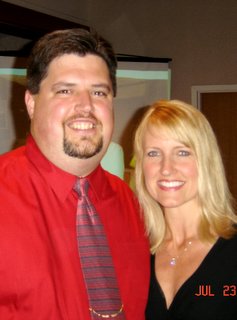 Rachel and I attended my 20th high school reunion in the Summer of 2005. What a surreal experience that was! I have put on a few...hundred...pounds since I saw these friends last, but it was a lot of fun! I wouldn't have missed it for anything! It was also the first time I have been back to Alaska since I graduated, and the scenery I used to take for granted was more beautiful than I had remembered. I'm going to try to add some scenery pics from the trip, if I can ...
How political should we become?
Have we become more of a political "special interest group" than a world-changing "new creation" of God? How far should we go in the inerest of trying to force a sinful world to behave with Christian values? How much time is spent trying to make people act right than we are trying to spread the good news of Jesus Christ? Is it effective in our witness to get angry at sinful behavior in a sinful society, or should we focus on showing love to the sinners who are bound by their sins? Most importantly, among believers, is it worth causing division in the body of Christ by arguing over which political party is right? Are either of the political parties right?
These are questions the church is going to have to deal with intentionally over the coming years, or we are destined to forget what we are and where our citizenship truly is. Yes, I believe America has been blessed by God, but it isn't because of our written codes or political practices. It is because the people putting those written codes into practice believed in God and desired to please Him. In the past, our leadership has operated with a genuine respect for God, from their hearts. Forcing people who don't genuinely hold God in the highest honor to act like they do is a huge mistake, because the outward actions fool only men, not God. God sent us into the world to change people, not governments. When the people are truly changed, they will elect government leaders who truly honor God, and His blessing will remain on us. The immorality that is running so rampant in America is connected directly to the rejection of God by the people. If the church is doing its job of reaching the lost and making disciples, it will be reflected in the leadership we elect.
So church, are we going to be a political party or the hands and feet of Jesus Christ to a lost and dying world? How should we then invest our time and efforts - Fighting the lost or saving the lost?
These are questions the church is going to have to deal with intentionally over the coming years, or we are destined to forget what we are and where our citizenship truly is. Yes, I believe America has been blessed by God, but it isn't because of our written codes or political practices. It is because the people putting those written codes into practice believed in God and desired to please Him. In the past, our leadership has operated with a genuine respect for God, from their hearts. Forcing people who don't genuinely hold God in the highest honor to act like they do is a huge mistake, because the outward actions fool only men, not God. God sent us into the world to change people, not governments. When the people are truly changed, they will elect government leaders who truly honor God, and His blessing will remain on us. The immorality that is running so rampant in America is connected directly to the rejection of God by the people. If the church is doing its job of reaching the lost and making disciples, it will be reflected in the leadership we elect.
So church, are we going to be a political party or the hands and feet of Jesus Christ to a lost and dying world? How should we then invest our time and efforts - Fighting the lost or saving the lost?
Thursday, January 12, 2006
Opening Day!
This is the first post on my new blog site. I've called it "The Scope" because I plan to cover a scope of things about the Christian life, what is happening in the "Christian World", and scriptural truths that apply to current events. I plan to write often, especially hoping to have something new here every Thursday. For today, just establishing this site is my accomplishment. For the coming days, I will be attempting to make this site known to the people of Croswell Wesleyan Church, our community and my family. At the end of each post there is an opportunity to respond. I would love to hear your views on every post. For this post, you can use the response option to let me know you've found me.
As I learn more about this stuff, I am sure things will keep changing and improving. Please be patient with me as I learn.
As I learn more about this stuff, I am sure things will keep changing and improving. Please be patient with me as I learn.
Subscribe to:
Posts (Atom)